Introduction to Phenomenology by Robert Sokolowski
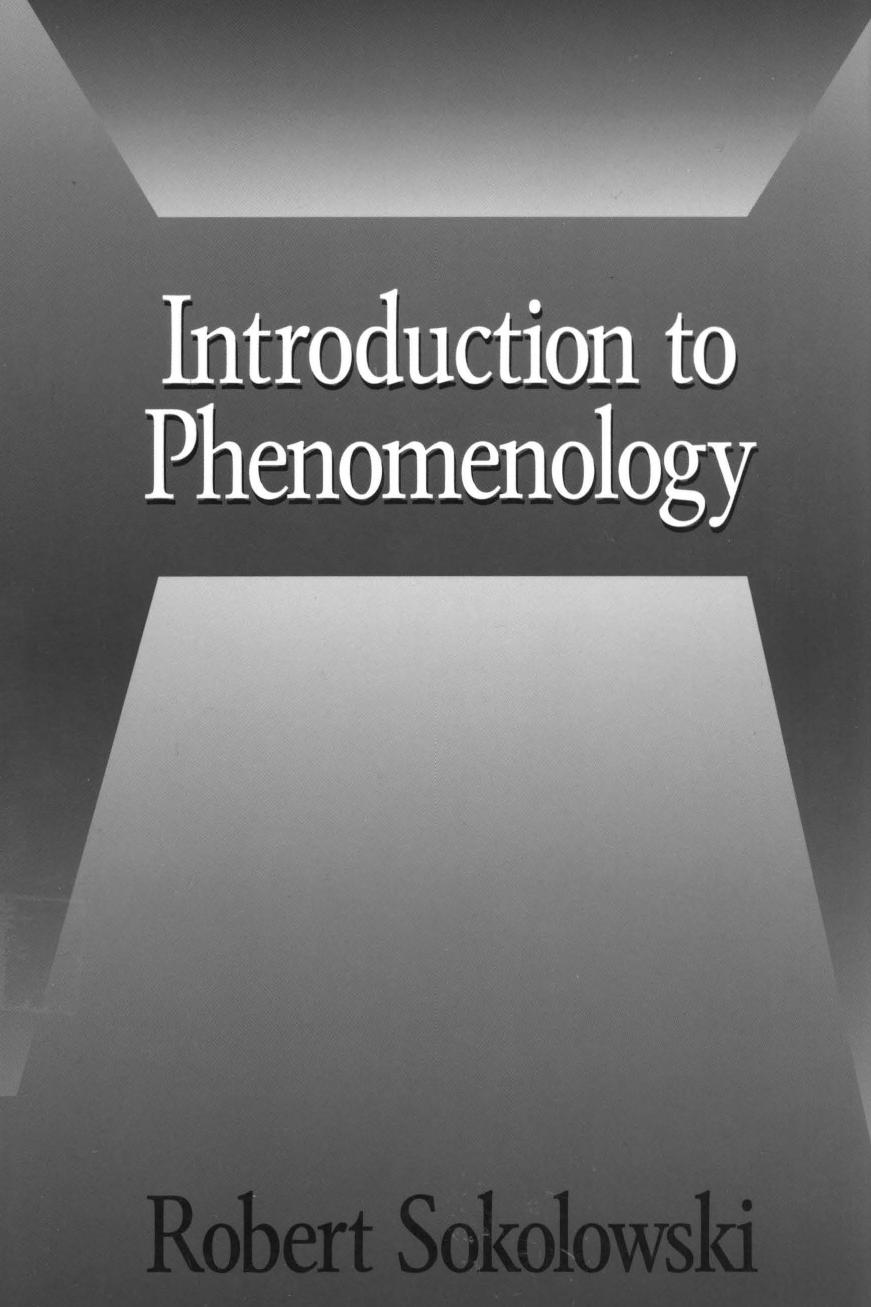
Author:Robert Sokolowski
Language: eng
Format: epub, pdf
ISBN: 0521660998
Publisher: Cambridge University Press
Published: 1999-12-31T16:00:00+00:00
WHAT IS THE TRANSCENDENTAL EGO?
We need now to consider the nature of the rational domain and how it differs from the biological and the psychological, how the transcendental domain differs from the empirical. We can do so by examining human knowledge and human virtue, both of which occur in the transcendental domain. The essential point to be made is that when we exercise our rationality, when we act as agents of truth and meaning, we become involved in activities that cannot be adequately treated from a merely empirical point of view.
Consider the natural sciences. Psychologism would claim that reasoning, argument, knowledge, and science are merely a matter of our psychological makeup. The sciences of physics, biology, and mathematics, for example, are said to be ways in which our organism adapts to its environment; they are not seen as telling us the truth about anything. The very idea of truth becomes problematic in psychologism; the judgments or propositions we make are ultimately just organic or psychic responses, not really all that different from the beating of the heart, the digestion in the stomach, or a mood of elation or depression. Even in the sciences, according to psychologism, we do not disclose what is; we just react.
In contrast, phenomenology would insist that even though we are biological and psychological creatures, even though our perceptions and judgments require a brain and nervous system and subjective reactions, when we get into the activity of judging, veritying, and reasoning, we formulate meanings and achieve presentations that can be distinguished from our biological and psychological way of being. They can be communicated to others, who may have subjective feelings that are very different from ours; they can be recorded, they can be used as premises in arguments, and they can be confirmed or disconfirmed. They have a kind of subsistence. They can be shown to be true or false in themselves, quite apart from our subjectivity. It is the meanings themselves that are consistent or contradictory; it is the judgments themselves that are true or false. Meanings and judgments belong to what can be called the "space" of reasons, and we enter into that space when we carry out categorial activities. Thus, besides being biological, psychological, and subjective beings, we also enter as agents into the space of reasons, we enter into the domain of the rational, and when we do so we "go beyond", we transcend our subjectivity; we act as transcendental egos.
Consider also the virtue of justice. As a child develops into a mature person, he becomes a rational being. He reaches a stage in which he can understand an argument and act according to its conclusions. He can work with ideas and not just with inclinations and feelings. In the early stages of life, the child is largely a bundle of tendencies and impulses, with only an inchoate rationality. As time goes by, the child begins to appreciate that he has to see himself as only one among many, that he cannot simply prefer his own satisfactions all the time.
Download
Introduction to Phenomenology by Robert Sokolowski.pdf
This site does not store any files on its server. We only index and link to content provided by other sites. Please contact the content providers to delete copyright contents if any and email us, we'll remove relevant links or contents immediately.
| Anthropology | Archaeology |
| Philosophy | Politics & Government |
| Social Sciences | Sociology |
| Women's Studies |
The remains of the day by Kazuo Ishiguro(9083)
Tools of Titans by Timothy Ferriss(8490)
Giovanni's Room by James Baldwin(7433)
The Black Swan by Nassim Nicholas Taleb(7195)
Inner Engineering: A Yogi's Guide to Joy by Sadhguru(6835)
The Way of Zen by Alan W. Watts(6670)
The Power of Now: A Guide to Spiritual Enlightenment by Eckhart Tolle(5854)
Asking the Right Questions: A Guide to Critical Thinking by M. Neil Browne & Stuart M. Keeley(5831)
The Six Wives Of Henry VIII (WOMEN IN HISTORY) by Fraser Antonia(5557)
Astrophysics for People in a Hurry by Neil DeGrasse Tyson(5224)
Housekeeping by Marilynne Robinson(4504)
Double Down (Diary of a Wimpy Kid Book 11) by Jeff Kinney(4332)
12 Rules for Life by Jordan B. Peterson(4331)
Ikigai by Héctor García & Francesc Miralles(4310)
The Ethical Slut by Janet W. Hardy(4307)
Skin in the Game by Nassim Nicholas Taleb(4306)
The Art of Happiness by The Dalai Lama(4167)
Skin in the Game: Hidden Asymmetries in Daily Life by Nassim Nicholas Taleb(4051)
Walking by Henry David Thoreau(3999)
